"IT'S A VIVRANT THING"
- Janae Long
- Sep 9, 2022
- 3 min read

"today I want to focus on an architectural style that is rarely spoken of and is pivotal part of not just New Orleans history but American history."
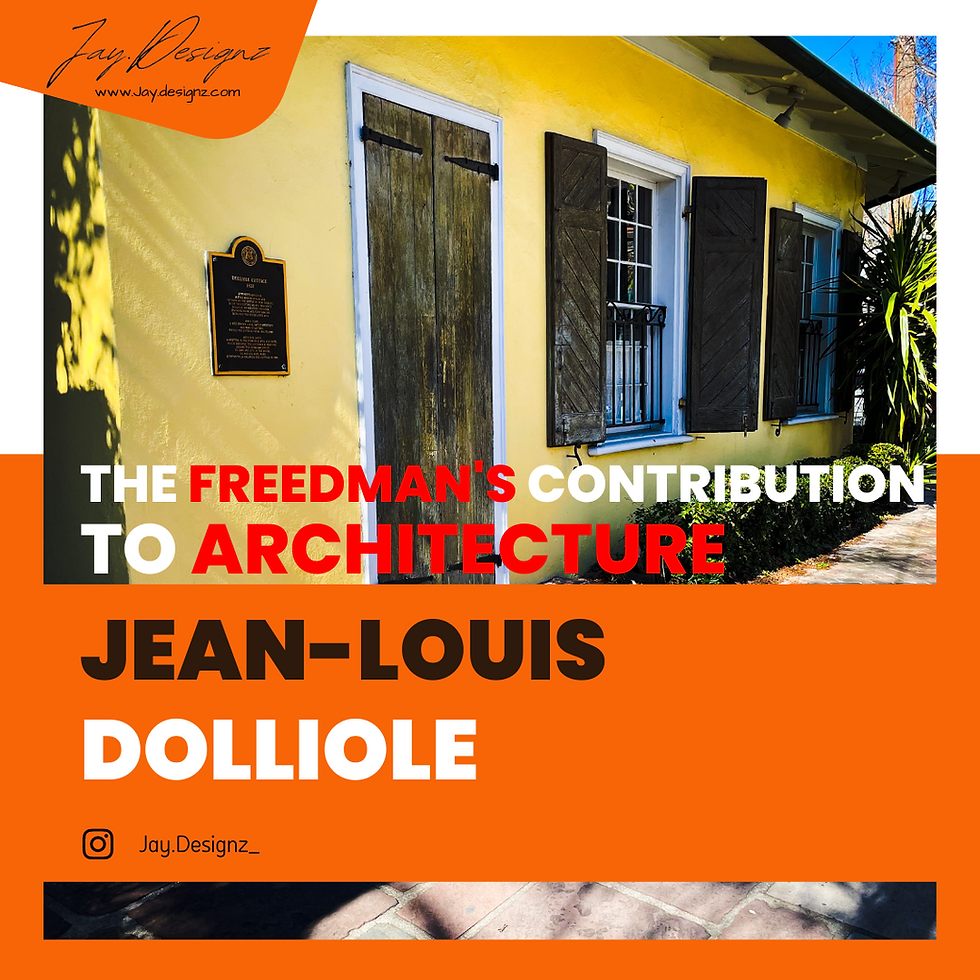
If you haven’t read Jean-Louis Dolliole - The Freedman's Contribution to Architecture, please check it out. The article begins discussing the era where slaves were able to obtain their freedom through different avenues during the 19th century. Once free, they began to build skills that would heavily influence and assist in the making of NOLA culture. The article goes on to discuss how freedman architects and builders were born out of this era and had a great hand in structuring the communities that are present today.
When thinking of architecture styles, Contemporary, Gothic and Art Deco are a few popular ones that most are familiar with. We can go on forever about those different architectural styles throughout the United States and the history behind them, but today I want to focus on an architectural style that is rarely spoken of and is pivotal part of not just New Orleans history but American history.
This architectural style was created by free men of color in the early 19th century called the “The Creole Cottage”. A few of the men that played a role in the formation of this style are Jean-Louis Dolliole, Louis Nelson Fouche and Norbert Souile. While Jean-Louis spent many years perfecting the “Creole Cottage” Norbert Souile contributed to what is called the Creole Townhome.
The Creole Cottage can be found off the Gulf Coast in particularly New Orleans and many parts of Florida and Alabama. The style consists of timber framed structure that sits on piers or blocks and has straightly pitched or hip gable roofs. During the earlier years of this design, homes were built on small foundations but as the designs improved the foundations became a little higher above ground; some believe this change was due to the water levels and debris that would sometimes enter the homes from the street. Many creole cottage homes in urban settings were built to the street or property line, increasing room for private space at the rear of the house while in some suburban settings where there is a bit more yard space, galleries[1] were added to the front.
Pictured below is the Dolliole Clapp house located on 1436 Pauger St. in the French Quarter and has an unusual spin on the creole cottage. This home is where Jean Louis and his first wife and 3 children resided. In most urban settings, the creole cottage has a hipped- roof but this property was designed with a pan-tiled gable roof and is pentagon in shape, instead of the typical square.

Pictured below is the floor plan of the Dolliole Clapp House.

These homes are usually dressed in bricks or bousillage [2] and contains two entrances; this was ideal for homeowners who wanted to rent out their homes and the second entrance could serve as a separate entryway for borders. Unlike the shotgun style layout that is found in Southern Regions, the creole cottage consists of rows of 3 to 5 rooms that open to each other and rarely includes an interior hallway. For smaller home designs rooms are positioned to be parallel to the gallery. Another unique feature includes “cabinets” towards the back of the homes that were utilized for storage space and served as access to the attic space above. Kitchens were sometimes detached for fire safety purposes, positioned at the rare of the property. Many of these homes can be currently found today in the French quarter and Faubourg Marginy.
Sources
http://www.frenchcreoles.com/new%20orleans/creole%20cottage/creolecottage.htm
https://64parishes.org/entry/creole-cottage
https://www.crt.state.la.us/cultural-development/historic-preservation/education/louisiana-architecture-handbook-on-styles/french-creole/index
https://prcno.org/new-research-explores-free-people-color-built-wealth-community-real-estate/
[1] Narrow balcony or platform running the length of a wall
[2] A confection of mud and Spanish moss


Comments